
When you set up a small company, you usually put your name on the Companies House form twice - once as a director and once as a shareholder.
It can feel like filling in the same box again.
They’re different, though, and the difference shows up the first time you pay yourself or bring someone new into the business.
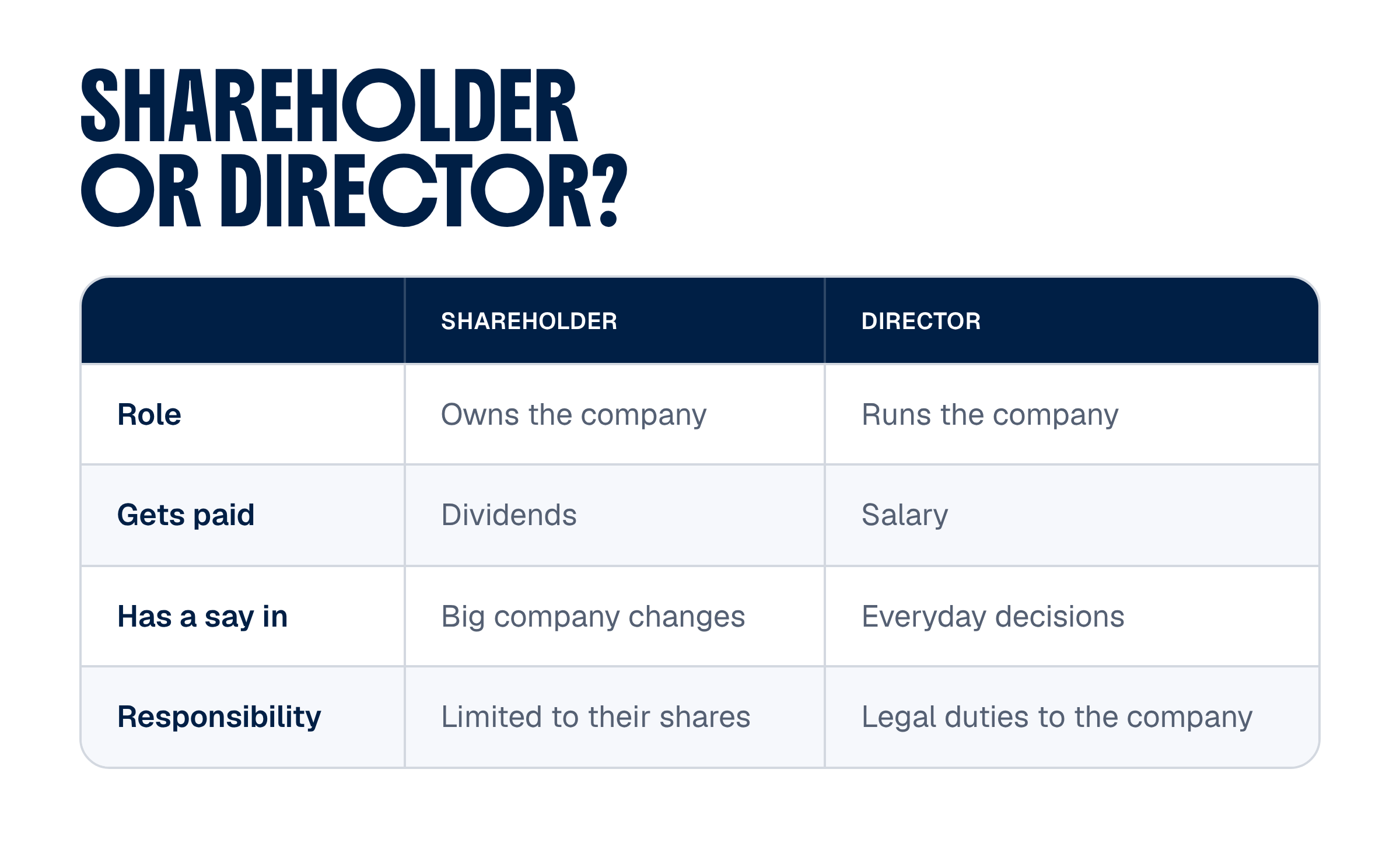
As a shareholder, you own part of the company or all of it. The more shares you hold, the bigger your part, and the more say you get when the company votes on something big. When there’s profit to share out, it goes to the shareholders as dividends.
As a director, you’re the one running it. You make the everyday decisions, sign contracts, hire people and make sure the accounts, tax returns and Companies House filings get done. Every UK company needs at least one director who’s a real person, aged 16 or over.
Yes, and in small UK companies it’s the usual setup. You can be the only director and the only shareholder at the same time, so a company can be a team of one.
The two roles can also belong to different people. A director can run a company without owning any shares, unless the company’s own rules (its articles of association) ask for it. A shareholder can own part of a company and stay out of running it, like an investor or a family member who put money in at the start.
When you hold both roles, you still switch between them depending on the decision.
A year-end dividend is a good example. Under the standard articles, which apply unless a company writes its own, you suggest the amount as a director and then approve it as a shareholder. You can approve a smaller amount, but you can’t go above the number the directors suggested.
Day to day, directors make the calls.
Shareholders come in when a decision changes the company itself, like removing a director, changing the articles or creating a new type of share. Most of these need more than half of the shareholder votes, and changing the articles needs a bigger majority. Votes usually count per share, so whoever holds the most shares has the most say.
The share split is really important when co-founders stop agreeing.
Shareholders with more than half the votes can remove a director at a general meeting, even if the director’s contract says otherwise. The person who’s removed keeps their shares, though, along with their votes and their part of any dividends, until they sell or transfer them.
Each role also gets paid its own way.
A director who works in the business can take a salary through payroll. The company registers as an employer, takes Income Tax and National Insurance from the pay and sends it to HMRC.
Shareholders get dividends, which come out of profit. The company can only pay out what it has in available profits from this year and previous years, and it usually has to pay every shareholder in line with how many shares they hold.
Each dividend needs a directors’ meeting, written minutes and a dividend voucher for everyone being paid. You need the minutes even if you’re the only director, so sometimes the meeting is just you and a notepad. Above a small yearly tax-free allowance, the shareholder may pay Income Tax on dividends.
If you’re both, you can take both, and plenty of owner-directors pay themselves a mix of salary and dividends. The best split depends on your own tax situation.
Anything you take out beyond salary, dividends, repaid expenses and money you’ve lent the company counts as a director’s loan, which has its own tax rules.
Once the money is yours, it’s easier to keep it in its own place.
An Ampere private account gives you a separate account and card for your salary, dividends and everyday spending, and you can move money into it from your business account. If your company has an Ampere business account, you can apply for one too. Get a private account
The biggest gap between the two roles is responsibility.
As a director, you have seven legal duties to the company under the Companies Act. In practice, you act in the company’s interests and within its rules, and you take reasonable care over your decisions. You also need to avoid conflicts of interest and speak up when you’d personally benefit from a deal the company is making.
You can hand the paperwork to someone else, but you’re still legally responsible for the company’s records, accounts and performance.
Directors who don’t meet their responsibilities can be fined, prosecuted or disqualified.
Shareholders carry much less. Their liability is limited to anything still unpaid on their shares, so if the company fails, they can lose the value of their shares, but the debts usually stay with the company.
Both roles end up on the public record at Companies House. Directors are listed by name, and shareholder details are on the record too. Your confirmation statement is where you check them every year and report any changes to who holds the shares.
Anyone holding more than 25% of the shares or votes also has to be registered as a person with significant control (PSC).
Since 18 November 2025, directors and PSCs have also had to verify their identity with Companies House. New directors do it before they’re appointed, and directors who were already in place do it with their company’s first confirmation statement after that date. Shareholders who aren’t directors or PSCs don’t need to.
If someone new is joining, settle the director vs shareholder question early. A co-founder might take both, an investor might only want shares, and a managing director you hire might only need the director role.
A shareholders’ agreement can cover what happens if one of them leaves, sells their shares or stops being a director.