8 things to check at every month end close

It’s the end of the month, and there’s a card payment in your account from a name you don’t recognise.
You’re fairly sure it’s printer ink.
Unless it’s that software you meant to cancel months ago and then forgot about.
A month end close is a short routine where you go through the month’s money and sort out mystery payments like that one while the answers are still easy to find. If you do it every month, your year end gets a lot calmer.
Start with the transaction list in your business account.
Match each payment from the month to a record, like a sales invoice, a supplier bill or a receipt.
If you use accounting software, check that its balance matches your account balance on the last day of the month. When the two numbers are different, it usually means something is missing or got recorded twice.
Finding it now takes a few minutes.
Leave it for a year and you’ll be scrolling through old emails trying to work out who bought what, and why.
Most of the gaps will be in card spending. Someone paid for parking. Someone else took a taxi to a meeting. A client lunch went on the company card, and the receipt is still in somebody’s jacket pocket.
Your company has to keep records of all the money it receives and spends, so each of those payments needs a receipt or invoice behind it.
You can try making it into a habit: pick one day each month when receipts are due from anyone who spends company money, and stick to it. And if you paid for something personal from the company account (easy to do when both cards sit in the same wallet), note it in your director’s loan account so every payment still has an explanation.
Team cards make the receipt hunt a lot shorter, because you know whose card each payment came from. With Ampere, you can issue cards to your team and set spending limits.
You’ll see what everyone spends as it happens, and if a card gets left in a taxi, pause it from the app. Once your Ampere business account is approved, apply for cards for yourself and your team.
Once the money going out makes sense, move on to the money you’re waiting for.
Go through your sales invoices, mark the ones that have been paid, and send a polite reminder for anything overdue while the work is still fresh in your client’s mind.
Then check for work you finished but haven’t invoiced yet. Small jobs slip through easily, and every week you wait is one more week before you get paid.
After that, look ahead to next month. Supplier invoices, rent, software and loan repayments can all land in the same week, and seeing them in one place helps you decide what to pay first and how much to keep in the account.
If you hold more than one currency, check each balance - paying a euro supplier from a euro balance saves you a conversion, and month end is a good moment to decide when to convert what’s left.
Tax deadlines come next. If you run payroll, even if the only person on it is you, your PAYE bill usually goes to HMRC every month. It covers the income tax and National Insurance from your payroll.
HMRC’s tax months start on the 6th, and the payment for each tax month is due by the 22nd of the next one if you pay electronically. If you’re VAT-registered, your returns usually cover three months. The return and the payment are both due one calendar month and seven days after the period ends.
If you’ve been doing your month end close every month, a big part of the quarter’s VAT work is already done by the time the return is due.
When a month end is also the end of a VAT period, use your close to make sure every sale and purchase from the period is in.
Before you file everything away, sit with the totals for a few minutes. Compare the cash you have at the end of the month with what you started with, and look for any cost that grew without a plan.
Those totals feed into most of the money decisions you make, from pricing your work to paying yourself.
Then put the month’s statements, invoices, receipts and payroll summaries in one place. A folder per month is plenty, and next year you’ll know where to look.
Limited companies must keep records for six years from the end of the last company financial year they relate to. Some need to stay longer, for example when the company has bought equipment that’s expected to last more than six years.
Month end close checklist
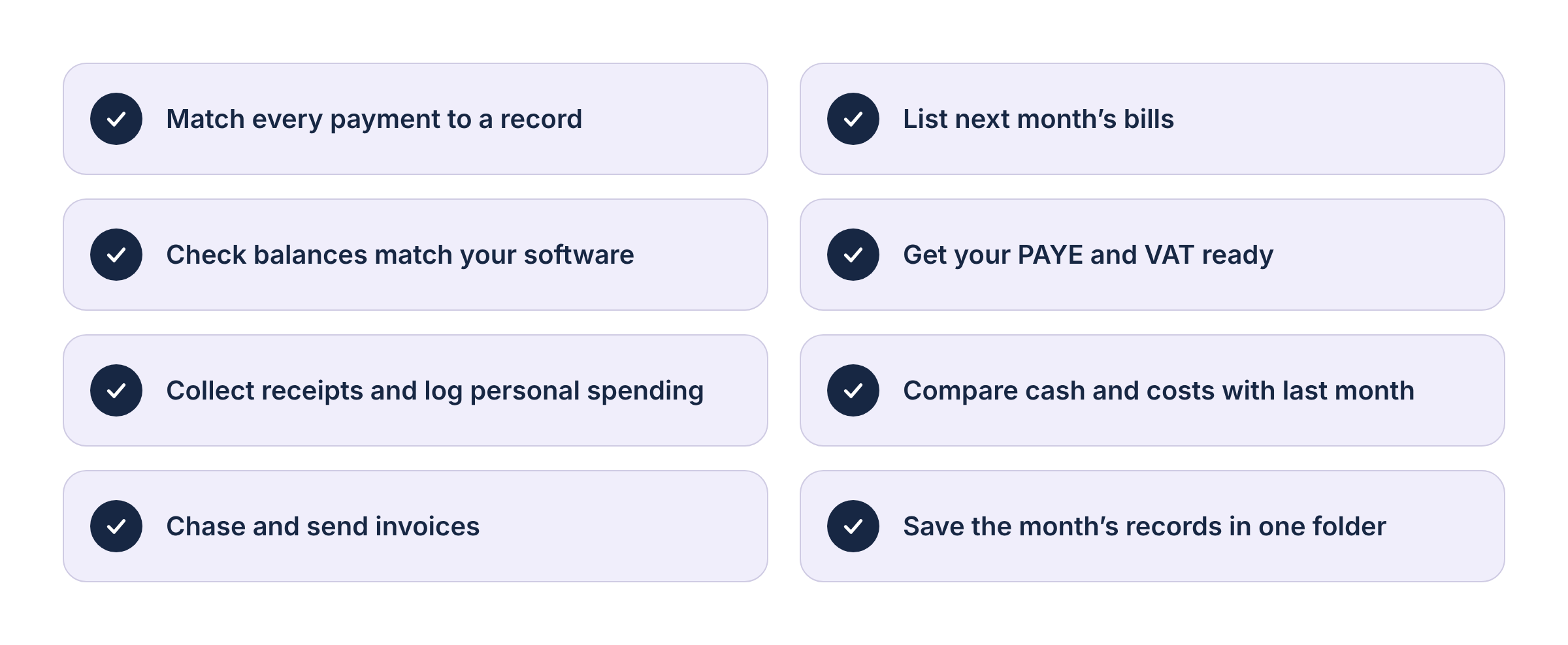
Save the month end close checklist somewhere easy to find, then pick a fixed day for it, like the first working day of each month, and put it in your calendar.
The first one will probably take a while, because you’ll be clearing up gaps from earlier months too. After a few rounds, the month end close process gets a lot quicker, and most months you can finish it in one sitting.