
The company had a good year, there’s a healthy balance in the account, and paying yourself a dividend sounds like the obvious next step.
Before you move any money, take a quick look at your retained earnings, though. They give you a first idea of how much the company can pay out.
The account balance is a different number, and it can be a misleading one.
Think of retained earnings as the company’s profit savings.
Every year, profit after Corporation Tax goes in. Losses come out, and so does every dividend you’ve already paid. The total keeps building over the whole life of the company, so a good year tops it up and a tough year pulls it down, sometimes below zero.
Dividends are paid from that pot of post-tax profit, which is also why they don’t lower the company’s tax bill. You can’t count them as a business cost for Corporation Tax.
On the balance sheet, you’ll often find retained earnings under capital and reserves, on a line labelled “profit and loss account”. Yes, the same name as the report that shows one year’s income and costs. Here it means the running total across all the years, and it confuses nearly everyone the first time.
Money in the account feels like profit, and some of it probably is.
The rest could be a business loan, a customer who paid upfront for work you haven’t started, or VAT you’re only holding until HMRC collects it. None of that is profit, so none of it adds to what you can pay out.
It can go the other way too - your retained earnings can look great while most of the money is stuck in unpaid invoices or stock on a shelf. A dividend needs both: enough reserves to make it legal, and enough cash to pay it on the day.
The number the law cares about
The legal limit comes from the Companies Act 2006, and it’s based on a slightly different figure, usually called distributable reserves. A company can only pay dividends from the realised profits it has built up over the years, minus its realised losses.
Realised profit has turned into cash, or into something close to it, like money a customer owes you for finished work. Most normal trading profit counts, so in a lot of small companies the two figures come out the same.
The usual exception is property the company holds as an investment.
If it goes up in value, the gain can be recorded in the accounts and added to retained earnings. Lovely for the balance sheet, but you generally can’t pay it out as a dividend while the company still owns the property.
The figures come from the company’s last annual accounts, the ones sent to shareholders. If those don’t show enough, you can use more recent accounts instead, and up-to-date management accounts usually do the job.
Then check what has happened since those accounts were made.
Maybe the company has made a loss in the last few months, or a big customer now looks unlikely to pay. Either one shrinks what you can pay, even if last year’s accounts looked fine.
Checking all of this is much easier when the books are up to date, because the numbers are ready when you want them. Our month-end close checklist helps you keep them that way.
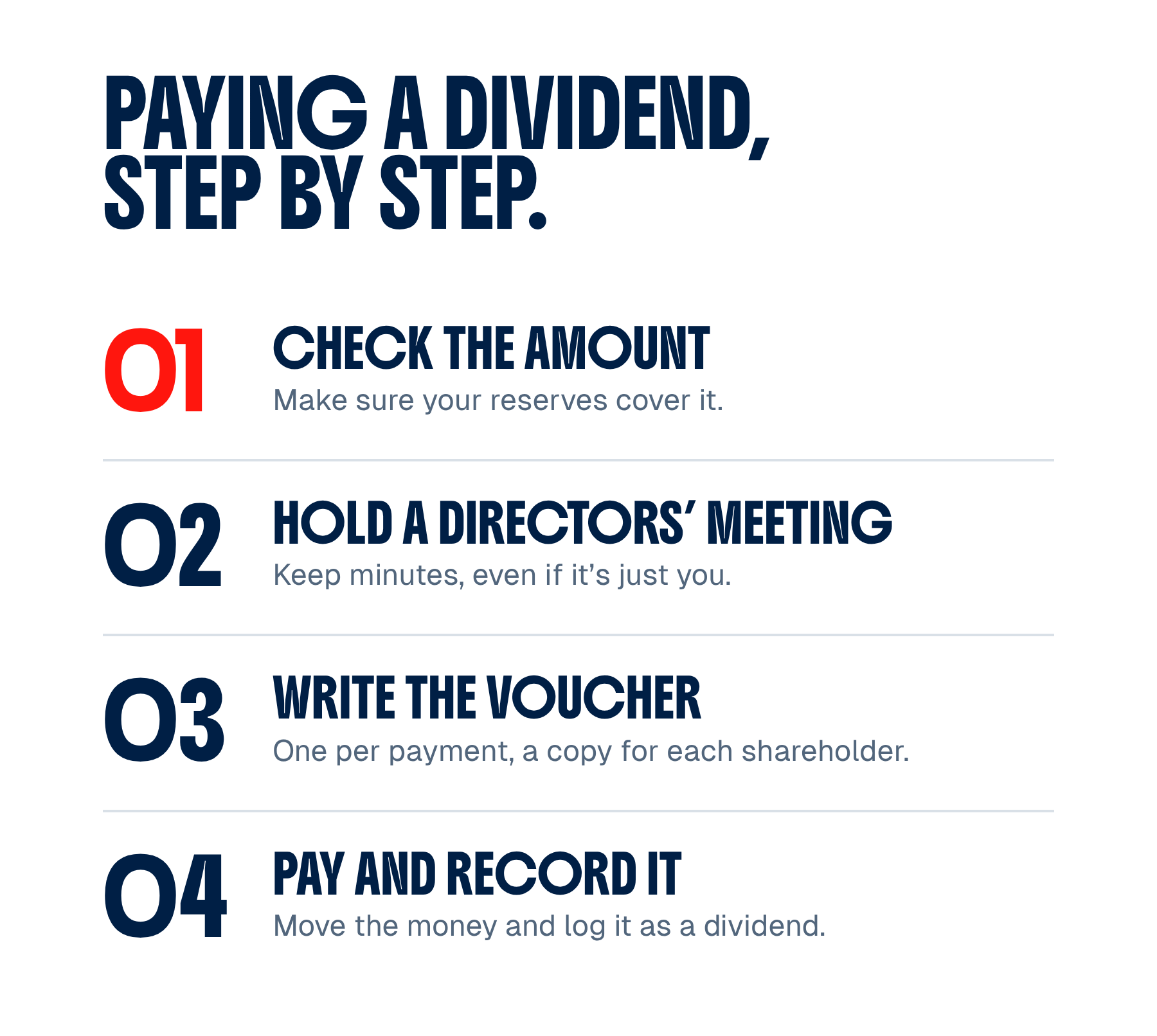
Once the amount fits, there’s a bit of paperwork. First, the directors hold a quick meeting about the dividend and keep minutes of it. That applies even if you’re the only director and the meeting is you, at the kitchen table, with a coffee.
Then, for each payment, the company writes a dividend voucher showing:
- the date
- the company name
- the names of the shareholders being paid
- the amount of the dividend
Each shareholder gets a copy, and the company keeps one. If there’s more than one shareholder, the dividend is usually split in line with the shares each one holds.
Under the standard rules a company gets by default, directors can pay dividends during the year by themselves. A final dividend needs the shareholders’ approval, and it can’t be more than the directors suggested.
In a one-person company, that’s you approving your own suggestion.
Then you move the money to each shareholder’s personal account and record it as a dividend in your books.
With an active Ampere business account, you can apply for a private account to receive your dividends. It has its own balance and card, so your personal spending stays separate from the company’s.
If a dividend goes over the limit
If a dividend is paid without enough profit behind it, or without the right accounts to back it up, it counts as an illegal dividend.
Company law says a shareholder who knew, or should have known, that a dividend broke the rules has to pay it back to the company.
When you’re both the director who approved it and the shareholder who received it, it’s hard to argue you didn’t know. Until you pay it back, the money is usually treated as a director’s loan.
It gets more serious if the company later can’t pay its debts. You could have to repay what you received, cover losses the company suffered, and face proceedings to ban you from being a director.
An overdrawn director’s loan can bring its own tax charges if it stays unpaid, so if you notice a problem after the money has gone out, get professional advice early.
Before your next dividend, start with your retained earnings and take off any unrealised gains, any losses since your last accounts, and any dividends you’ve already paid since then. Then make sure the cash is there on the day.
You can always pay less than the maximum. Keeping a bit in the company means the next Corporation Tax bill or a slow month won’t leave it short.