
A SIC code usually gets chosen in about a minute, somewhere between picking a company name and typing in the registered address. Then the business changes direction or finally starts trading, and those five digits stay as they were.
Fixing it takes a confirmation statement, which you can file early whenever the code needs changing.
Your SIC code is the register’s short answer to “what does this company do?”
Companies House keeps a condensed list of more than 600 codes in 21 industry sections. You need at least one, and you can choose up to four if the business does a mix of things.
Even a company doing nothing at all has a code for it. Dormant companies use 99999, and non-trading ones use 74990. LLPs get to skip this one, since Companies House doesn’t ask them for a code.
Companies House can now question or remove details on its register that look wrong. In May 2026, it said that includes your SIC code.
One of the mismatches it sees most often is a company that’s trading while its record still says dormant or non-trading. If your code doesn’t fit what you do, a filing can be rejected or held up while Companies House looks into it.
Lenders and funding providers check SIC codes too, to see if a business fits what they offer, and anyone can find yours on the public register.
A code from two business models ago can make a perfectly normal application look odd.
A new direction often brings new kinds of payments too. If you’ve started selling to clients abroad, an Ampere business account lets you get paid in euros or dollars and keep them that way until you need them. Open a business account and, once you’re approved, manage it all from your phone or laptop.
Finding the right code
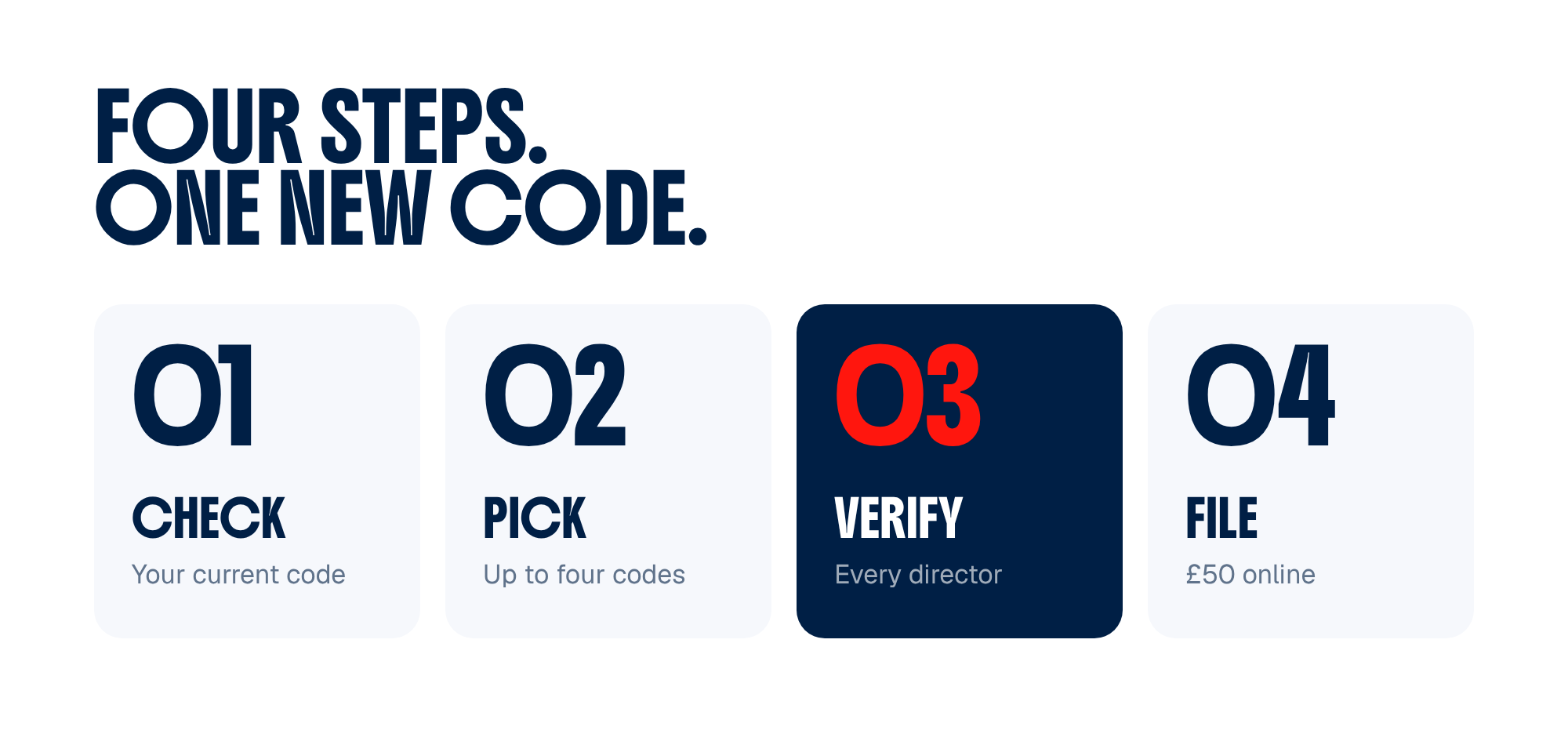
Start by checking what’s on file now.
Search for your company on the Companies House register (the Find and update company information service), and your codes are listed under “Nature of business (SIC)”.
Stick to codes on that list, since Companies House may reject a filing with one that isn’t there.
If your business sits between two codes, the official tip is to look up a few similar companies on the register, see what they chose and go with the closest match.
You might have heard that the Office for National Statistics published a new classification, UK SIC 2026. Companies House is still using its current list. In June 2026 it said a future framework was under discussion and would need a change in the law, so the condensed list is the one to use for now.
How to change SIC code on Companies House
To update SIC code details, you file a confirmation statement (form CS01), the yearly filing that confirms your company details.
You can file it any time during the year.
Doing so starts a new 12-month review period and moves your next due date. Filing online costs £50 and paper costs £110, but Companies House only charges once per 12-month payment period, so a second statement in the same period won’t cost you again.
The step most likely to slow you down is identity verification.
Every director needs to have verified their identity with Companies House, and the statement asks for each director’s personal code. Companies House won’t accept it until all of them are verified, so one missing code can hold up a simple five-digit change.
Each director only verifies once, either online with GOV.UK One Login or through an authorised agent such as an accountant or solicitor.
To file online, you’ll sign in with GOV.UK One Login and enter the company’s authentication code. Companies House posts it to your registered office, and you can ask for a new one if it’s gone missing.
Once your statement goes through, the new code shows up on the public register. If you file by post, SIC changes go on a separate page of form CS01, sent together with the main statement.